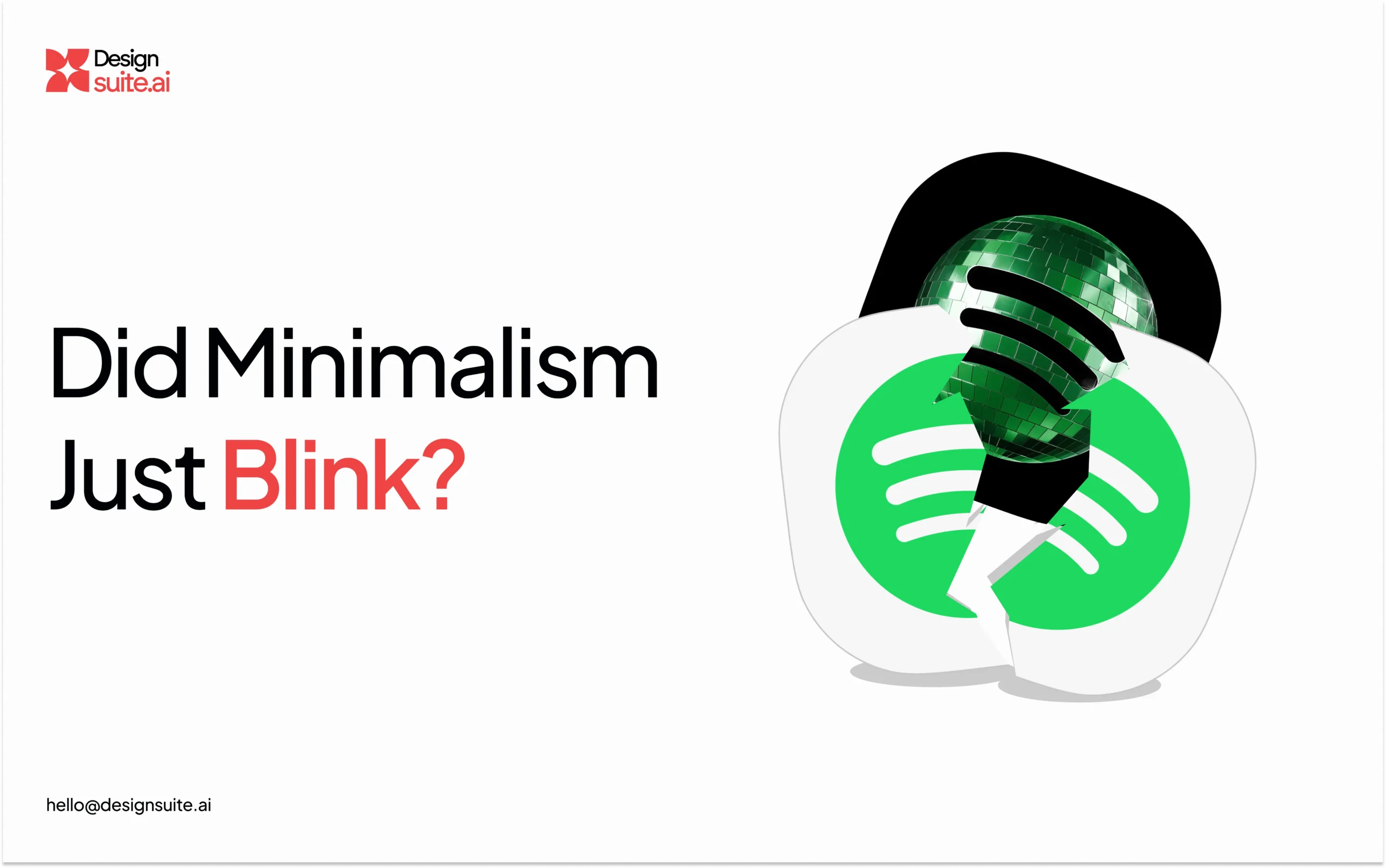
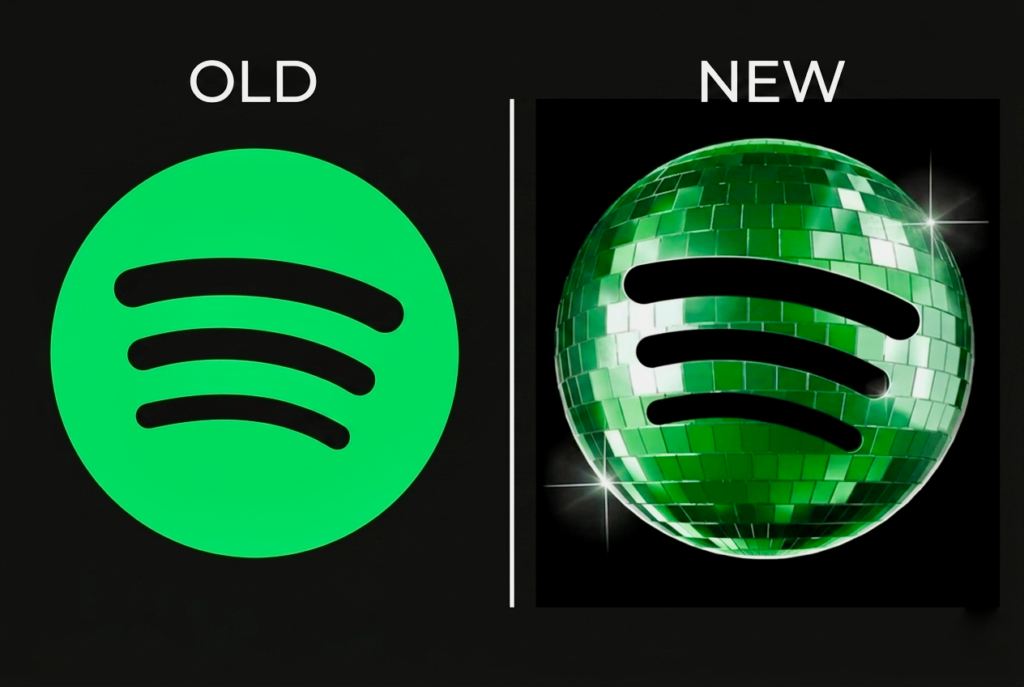
There was a time when every tech company wanted to look invisible. Flat icons. Muted palettes. Sans-serif everything. White space so clean it felt almost clinical. For the last decade, digital design was obsessed with restraint. Minimalism helped products scale, created clarity, and made interfaces feel modern, efficient, and universal. And it worked, for a while. But something interesting is happening now. Spotify recently transformed its icon into a glowing disco-ball-inspired visual, vibrant, reflective, loud, emotional, playful. We decided to experiment with the same visual direction at designsuite.ai, not because it is trendy, but because it represents something much larger happening in design culture right now.
The question is no longer “how minimal can we make this?” The new question is: how memorable can we make this feel?
The age of safe design
Open any startup website from 2018–2024, and you’d likely find the same visual language: soft gradients, rounded cards, neutral typography, monochrome icons, airy layouts, and “professional” minimal interfaces.
The problem? Every product started looking interchangeable. Minimalism solved usability problems, but over time, it created a branding crisis. Products became easier to use, yet harder to emotionally remember.
“In a world where AI can generate polished interfaces in minutes, visual sameness is becoming increasingly dangerous. Good-looking design is no longer enough.”
Emotion is becoming the differentiator.
Why maximalism is quietly returning
The new wave of design isn’t abandoning minimalism completely, it’s evolving beyond it. Brands are reintroducing texture, motion, depth, metallic surfaces, gloss, nostalgia, dynamic lighting, experimental typography, and personality-driven visuals.
Spotify recently transformed its icon into a glowing, reflective, emotionally charged visual, vibrant and loud. That disco-ball aesthetic is more than decoration. It reflects a cultural shift toward expressive interfaces that create mood, identity, and energy.
In many ways, the internet is becoming human again.
How AI is accelerating this shift
Ironically, AI may be the reason minimalism fades faster. AI is exceptional at generating “good enough” clean design. Clean layouts are now commoditised.
The new premium: If every AI tool can instantly generate beautiful typography, balanced spacing, polished cards, and modern gradients, then originality, emotion, taste, creative direction, and cultural relevance become the real differentiators.
The future of design is no longer about arranging rectangles. It’s about building experiences people remember. That changes everything.
The return of digital emotion
The next generation of interfaces will feel more cinematic and sensory, not chaotic or overloaded, but expressively designed. Here are five emerging design trends already taking shape:
Gloss & reflective surfaces
Chrome finishes, holographic lighting, metallic textures, and translucent materials. The flat era is giving way to dimensional interfaces.
Motion as identity
Microinteractions are becoming branding elements, not just usability tools. Movement is becoming personality.
Bold colour psychology
Brands are abandoning “safe startup blues” for emotionally charged palettes, neon, red, electric gradients, and high contrast.
Nostalgia-driven design
Y2K aesthetics, retro-futurism, and tactile interfaces return because they feel emotionally rich in an AI-generated world.
Interfaces that feel alive
Dynamic systems, adaptive visuals, reactive environments. Software is becoming an experience layer, not just a tool.
Does This Mean Minimalism Is Dead?
Not at all. Minimalism remains one of the greatest principles in design history. But what is ending is soulless minimalism.
The future belongs to products that combine clarity with emotion, simplicity with personality, and usability with memorability. The best interfaces of the next decade won’t be the emptiest ones; they’ll be the ones that make users feel something.
What this means for your brand
Most companies still treat design like decoration. That mindset is becoming expensive. In the AI era, branding and emotional differentiation matter more than ever. Products that fail to create a visual identity risk becoming invisible.
“Your interface is no longer just a UI. It is your positioning, your emotional signature, your trust layer, your brand memory.”
Design is becoming strategy, again.
Our Take at designsuite.ai
At designsuite.ai, we believe the future of UI/UX isn’t about blindly following trends. It’s about understanding cultural shifts before they become mainstream. The industry spent years optimising for usability. Now it must optimise for memorability.
Because the next generation of digital products won’t win by looking clean alone, they’ll win by becoming unforgettable.
Beyond Just Design
Where we explore the future of interfaces, branding, AI, and digital experiences before the industry catches up.