When users don’t understand what’s happening, trust collapses, friction increases, anxiety rises, and conversion drops. This is where one timeless UX principle becomes more important than ever.
The system should always keep users informed about what is happening – Jakob Nielsen, Visibility of System Status
Sounds simple. But in AI products, this principle becomes the foundation of trust.
Traditional UX vs AI UX
Traditional software was predictable. You clicked a button. The system performed a rule. Simple.
AI systems are different. AI systems infer, predict, hallucinate, retrieve, reason, and adapt dynamically. Which means users constantly ask themselves:
- “Why did it say that?”
- “Is this accurate?”
- “Can I trust this?”
- “What is it doing right now?”
- “Should I wait or retry?”
If your interface cannot answer these questions clearly, your AI product already has a UX problem.
The New Role of Designers
Designers are no longer just interface creators. Modern product designers are now:
- Trust architects
- Cognitive experience designers
- AI interaction strategists
- Communication system builders
The future of UX is not just designing screens. It is designed for clarity.
What Great AI System Visibility Looks Like
The best AI interfaces today don’t feel magical because they hide complexity. They feel intelligent because they reveal the right amount of complexity.
Look at platforms like: ChatGPT | Perplexity AI | Notion AI | GitHub Copilot
These products continuously communicate what the AI is doing, what sources it uses, when it is processing, what users can control, and how outputs are generated. That visibility creates confidence.
The Illusion of Speed
One of the most fascinating things in UX psychology: users tolerate slow systems surprisingly well, if the system communicates effectively.
A 6-second wait with streaming responses, progress indicators, animated skeleton loaders, or visible reasoning states often feels faster than a silent 2-second freeze.
Uncertainty feels longer than waiting..
AI UX Is Really About Anxiety Reduction
Most teams think AI UX is about futuristic interfaces, chat layouts, fancy animations, or prompt boxes. It’s not. The real job of AI UX is reducing user anxiety.
Good AI visibility answers five critical questions:
- What is happening?
- Why is it happening?
- How confident is the AI?
- What can I control?
- What should I do next?
When users understand these things, trust increases dramatically.
The Dangerous Design Trend Right Now
Many startups are over-optimizing for “magic.” They hide system logic, confidence levels, processing states, and AI limitations. At first, this feels impressive. But eventually, users realize the system is unpredictable. And once trust breaks, retention drops fast.
The future belongs to products that are transparent, collaborative, explainable, and controllable, not products pretending AI is perfect.
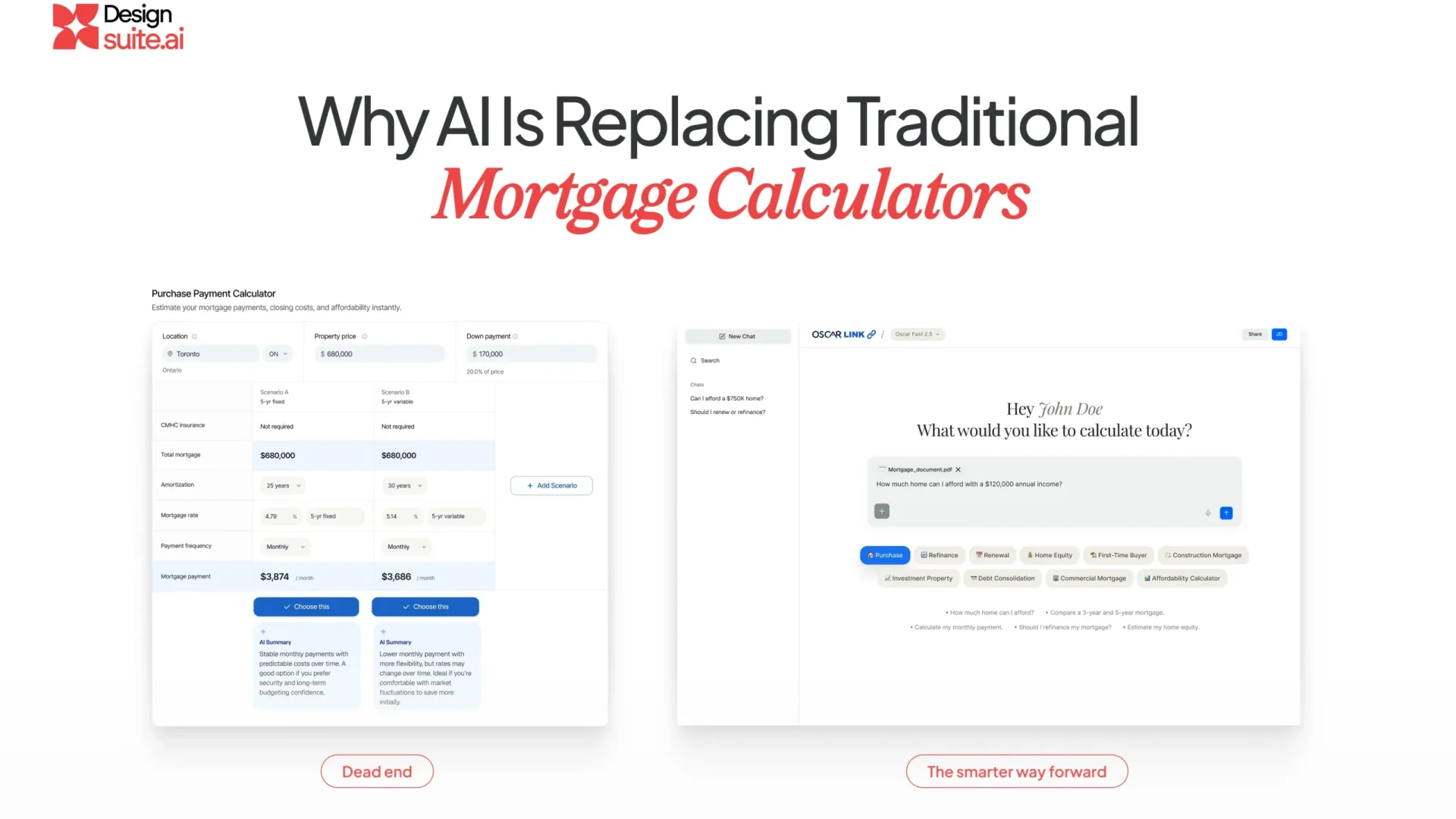
The Shift From UI Design → Trust Design
This is the biggest transformation happening in product design today.
Old UX focused on
- Navigation
- Layouts
- Visual hierarchy
- Responsiveness
AI UX focuses on
- Trust calibration
- Explainability
- Confidence communication
- Human oversight
- System transparency
The designer’s role is evolving rapidly. The next generation of elite product designers will not just understand typography, grids, or color systems. They will deeply understand psychology, cognition, AI behavior, human trust, and decision-making.
What We Believe at designsuite.ai
At designsuite.ai, we believe the future of design is not about making interfaces prettier. It’s about making intelligence understandable.
The best AI products in the next decade will win because they communicate clearly, reduce uncertainty, guide users confidently, and make people feel in control.
That is where design is heading. Beyond visuals. Beyond screens. Beyond just design.
Get a Free AI-Powered UI/UX Audit
If your product has low conversions, poor retention, confusing workflows, weak onboarding, unclear AI interactions, or inconsistent user experiences, our team at designsuite.ai can help.
Our audit analyzes
- Usability flaws
- Conversion bottlenecks
- UX friction
- AI visibility gaps
- Trust issues
- Onboarding problems
- Accessibility concerns
- Interaction inconsistencies
You’ll receive strategic insights on how to improve user trust, product clarity, engagement, and conversion performance, because in the modern AI era, great products are no longer judged only by what they can do. They are judged by how clearly they communicate it.